

Showing posts with label Musing. Show all posts
Showing posts with label Musing. Show all posts
Wednesday, March 24, 2010


Wednesday, February 3, 2010
Apple
I've been thinking about blogging about Apple for a long long time, the bashing of Apple's product by supposedly "smart" people constantly fuel my intention to talk about what i think apple is about. By the way, I do not think i'm smart, i'm just wondering how those people got there (associated with intelligent) in the first place.
To be continued . . .
Read more...
Monday, November 23, 2009
Icsid World Design Congress 2009
I've just came back from Icsid World Design Congress 2009. It is the first of 3 days of this congress and i must say there are some pretty good discussions going about among the studio leaders. Bruce Nussbaum of businessweek and Singapore Minister of Finance Tharman Shanmugaratnam got the day started with some really good discussions. Both of them obviously really know their stuffs. I've always appreciated people who speaks because he does have a point rather than someone who does that for a statement or just to grab some attention. Unfortunately congress like this often is a magnet for attention seekers as well, as the day went on, you start getting people who will grab any chance to stand up, have the cameras on him and ask the most out of point questions ever. Somehow it's always that few people asking the same few questions.
Most of the speakers are really people with substance, however I find the rest to be too idealistic in their views. They seem to be like they have just rejoined civilization after a really long period out. I'm very sure anyone who reads the newspaper and watches TV (someone who's not out of touch with society) will be able to say, "Yeah i think we should cut down on our spending and move away from this consumption driven society." The question is then how do u propose that happening? Yes rat is a stable in some developing society, but that's because those rats are feeding on natural grains and etc. I don't think rats in cities are safe for consumption really. Even the pigeons in Singapore are known to spread disease with their droppings. Even if we get pass that fact, i do not see the human race moving pass this habit of consumption easily. The consequences are unimaginable.
To be really frank, design and the green movements are really so huge because they push sales. People spend money thus the economy thrive. If people stop consuming, companies will basically go bust, workers lose their jobs and the economy go bust. I think the key is to educate the world to cut down on unnecessary spendings. Products to reduce unnecessary parts and styling, with gimmicks totally taken out. I think we already are moving towards that, although most of the time still really superficially.
Another observation I've made on the first day, is that most designers are really pessimists. Maybe they are just jumping on the bandwagon, but most of their visions of the future are really really dark. I really hope they are bad prophets. Anyway visions of the future have always been more about the present than anything else so that really shows the confidence those designers have of today's world. Bruce Nussbaum made a comment which i totally agree as he said (after a long contemplation) that he had gone through a lot of really dark period, and it always turn out fine. Personally i think what he really wanted to say is that he do not think the earth is as bad as what the media has made of it, but obviously that's not really politically correct thus he decided to rephrase his reply. Anyway to be really frank, i'm wondering, other than the forest fires and pollutions that we're so responsible for, can anyone be sure the change in climate is really our fault? If the scientists have been right to say that the earth has gone through the ice age to the present date, hasn't the earth been constantly heating up then? Maybe the dinosaurs have been producing too much carbon dioxide then. Many scientists also agree that the earth plates have been shifting since its existence. They hypothesize that all the land are joint and the shifting of the crust resulted in our landscape today. If the land area remained about the same, while area covered by the ocean increased dramatically, isn't it to say the earth actually expanded? That alone will result in major errors to our calculations, the poles melting may simply because it is shifting or even earth trajectory have shifted. Anyway we now know that the space is actually expanding, and that by itself also results in shifting of path of the earth...
What i am trying to get across is that with so many other possibilities that we can't prove, why we are so dead on on that possibility that we are the cause? However, on the other hand, i do believe that there's no harm on cutting down on mindless expenditures.
Monday, November 16, 2009
"Barefoot" Running
I've hardly been blogging for a period of time, partly because of my reservist and partly because i decided to spend my free time running rather than gaining weight LOL. With the view that Standard Chartered Singapore Marathon 2009 is coming up, i decided to talk about running in this post.
Having seen the title to this post, you should have already guessed that i'll be talking about "barefoot" running. Basically the idea is that researchers have discovered that people in more developed country seem to suffer more from running related injuries as compared to citizens of less well off countries. There are in fact published researches that show runners wearing "better" pairs of running shoes to suffer more from injuries associated to running compared to runners who are wearing poorly cushioned and supported shoes.

Picture taken from http://www.barefootrunner.com/barefoot-101/
The image above explains the reason behind it pretty well. Our feet have evolved to the present form for a reason. By introducing cushioned shoes to our feet, we're changing the way we run. Without padded heels support from shoes, no one in the right frame of mind would have tried to run by landing on their heels (what everyone's doing now with shoes). This action will result in a very sore heel that will inevitably lead to the runner trying other method of landing their feet. They will finally settled down to landing on their forefoot, which is "designed" to flex and cushions such impact. This change in landing method will prevent the locking of your knees and back while you run, the impact thus doesn't get transferred to them. In fact we tend to land way heavier when we are wearing shoes as we can't feel the pain and the ground with the thick cushion in between. The pain from the heel in this case is a signal to tell you that you are running the wrong way!
Running shoes are also design to prevents your feet from working too much. In the long run, your feet start losing their ability to work to their best of ability without the shoes. With less than fully developed feet, we will start getting too dependent on shoes. We then get injured easily in the absence of them.
Thus recently, I've been running with Nike Cortez Flywire shoes below.
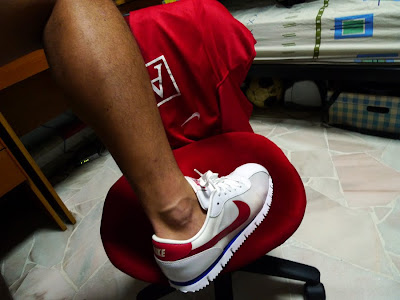
You can see the slits on the soles that allows it to flex. To be frank, i'm not even sure if they are designed to be ran in. The arch support is almost non-existence, but as I've always been a forefoot runner, I've not have much problem running in these (My friends have always commented that i look more like bouncing than running as a result of my running style). I've since progress from running in them from 5km to about 12km per run to date and so far everything pretty ok. The only problem is that it feels too flimsy to sprint while wearing them. Thus i will wear another pair of shoes if i know i'm gonna do circuit training.
 From a design viewpoint, I've always struggle between creating a product that helps and improves people's life or should we design to really benefit users without making them suffer in the long run. As a result of technologies, we become over reliant on technologies such as handphone and personal computers. I'm sure most of us can remember that we used to be able to recall telephone numbers of all our friends by heart, now how many can still claim to do that? Thus i'm a strong believer of "too much help is no help" and hopefully there are many more designers out there who share my view on this. This case also shows that conventional wisdom may not be always correct, by understanding deeper issues and how things works, we tend to get really useful insights.
Read more...
Tuesday, August 4, 2009
What makes a good designer?
I remember attending this talk by Dick Powell and one of the audience asked the usual question like what do you think makes a good designer. He paused for a while and hesitantly replied, "A good designer is one who can draw very well". A person's answer often tells you a lot about himself/herself, in this case i can know for sure Dick Powell is definitely someone who can draw damn well. However i'm very disappointed with that answer as he probably should just go get any comic artist out there to be designer and surprised that he actually doesn't already have an answer to this question.
Personally i think he's partly right to make that statement because a person who can draw well is usually someone who has observed the things around him/her to an certain extent. This together with their visualizing skills allow them to represent their ideas in their drawings. When you are drawing, you are really picking out features, hint, semantics and etc to communicate an idea of what you are trying to represent. Depending on your style of drawing, you almost certain to practice a form of minimizing (keeping the essence while taking away the unnecessary). Thus you are more sensitive to curves and lines etc. Some people call this intuition, and because they do not really know why they feel certain way, they also call it an art. But really, i think it is something that can be and should be understood.
To me what makes a good designer will be someone who's observant to things around them. He/she understands why people react a certain way, how trends are started, why a certain lines doesn't complement another. They can turn a sub conscious decision into a conscious effort.
Lastly to design a good product, I really think a designer needs a good rational mind and critical thinking skills. This is because when faced with factors coming from technology, environment, psychology, manufacturing etc you are almost certain to have many clashes of ideas. This is when you have to weigh what is necessary and what's not and trade them off in a well thought out manner. This is a key point that differentiate a good designer from an comic/art artist. While an artist maybe able to create beautiful object, they may not be able to be realistic enough to do something that's manufacturable and functional. They may be too drawn into their own world to realize people in the real world doesn't behave the way they imagine them to be.
The Ideal designer will probably have all these skills, however i'm sure most of you have seen sketches of famous designers (1,2) that are oh no so inspiring, but still their final products are works of "arts". So i will put good observation and critical thinking skills as the most important point a designer should set out to attain.
Monday, August 3, 2009
Alain de Botton: A kinder, gentler philosophy of success
I like what this guy talked about here. Something which I have always believe in is how the people have been influence (by movies, advertisement, news) to believe in what they want. The TED talk by Dan Ariely has shown how our decisions are easily influenced by our options. There are people who want to do well in every single thing in order to be happy. These people often end up to be really miserable.
However I know there's a paradox in this belief as well because the whole human race may stop progressing if this level of competition is gone. If everyone just accept failure as something not due to himself/herself then we may find ourselves living in a totally different (maybe worst?) world. The key i think is to be able to make a mark and say yes this is enough, not in the barely enough sense but to be comfortable enough.
Read more...
Wednesday, July 29, 2009
Design is
People think that design is styling. Design is not style. It’s not about giving shape to the shell and not giving a damn about the guts. Good design is a renaissance attitude that combines technology, cognitive science, human need, and beauty to produce something that the world didn’t know it was missing. — PAOLA ANTONELLI
Yes i cannot stand people who talks about design as styling, especially when they are supposed (self proclaimed) to be a design thinker.
Wednesday, July 22, 2009
Sky Armor
What caught my eyes is the unique way the propellers are placed and positioned. By aligning them at an angle, it allows the toy to change directions without the need to tilt like normal helicopters do. This could be a very good function for real life helicopters.
However before you get too excited and go design another concept helicopter, this is not a realistic way of doing things because it results in the blade ending lower than normal. As a result it
(1) needs bigger open area to land
(2) the propellors have to stop moving before anyone can get in and out of the helicopter.
I can think of a couple more points but just these 2 points are enough to make this a stupid idea for real life applications. Obviously we can solve the problem by simply placing it taller, this results in a helicopters becoming much taller itself, resulting in
(1) more materials needed
(2) more weight
(3) increase air resistance?
Actually i've thought of a better solution by making the motors tiltable, but it meant that it probably will be more of a hybrid of a plane and helicopter as it requires clearance between the 2 blades.
Anyway this robot needed this because it is standing up and way harder to make it change direction by tilting.
Read more...
Sunday, July 12, 2009
Good Design is all about the Attention to Details!
I'm not a fan of big revolutionary ideas. Thus most of the time i do not really see the value in coming up with concepts that can't be made. When you try to change the world, the world has to change and that is a big problem.
Very often i see people coming up with a new (sometimes better) way of doing things, it may cost the same as it's competitors, but it has a big problem, everything else needs to change. People gotta reinvest in infrastructures, send people for training and throw away their old equipments that cost a fortune.
What happened is nothing will happen. Unless it's benefits are really significant. This is why certain things just never change, like how you hope self assembling PC can be much easier, why electric plugs still looks the same after so many years.
I prefer design that pays attention to details, small little things that people do not think matter. These small little things often create irritation for the user in the long run. One example is this medicine bottle designed by Deborah Adler. A medicine bottle with a label that's easy to read. Small idea big benefits. (I can totally imagine some guy proposing using some OLED sorta display for something like this and fitted with solar panels so it's earth friendly and finally the hospital will have a system to update all the display through wireless technology). In this case, it's the execution, the attention to details that's key to its success. Good execution is the key to any success. So please do not dream about big ideas only, pay more attention to the detailings of the design.
Read more...
Friday, July 3, 2009
Chimpanzees learn from video demo
Just saw this post on BBC News, that talks about Chimps building their own tools after watching video demostrations. The Chimps were broken up into several groups and shown progressively shorter video of less information. To their findings, the group of chimps who had see the full video can easily replicate what they had seen and build the tools easily, while a handful of those exposed to less information can build the tool. Then the reseachers noticed an interesting phenomenon.
"What was interesting about this group was that, when we presented them with the grape at different distances from the cage, they made the appropriate tool to reach it. Those that had been shown the full demonstration, and had socially learned to make the longer tool, continued to make it even when the grape was so close that it was more awkward to use.""It could be that social learning is such a strong force for the chimps that they apply a blanket rule of 'go with what you've seen' (rather than work out what's most appropriate for the task)."
They are now trying to test their findings on young children and personally i think they're just going to get the same results. I think the chimps are totally demostrating what human beings will do if they are exposed to the same thing. We quickly accept and settle on a single solution that was taught by others, usually without questioning why was it done in that way. We are usually lazy to think so we will just follow what has proven to be useful. Very often when i questioned why certain friends did something, they will answer ,"I never think so much la". This answer never fails to irritate me. The group of chimps that built their own tools have thought through the process and understand what needs to be done and why, thus able to come up with the more efficient method.
In fact there were some research done that asked participants to draw what they were shown on the screen. They will be shown pictures of a real kitten and the outcome of their drawings will be a caricature of a kitten, simple line works that most easily represents a cat. They were then hypnotized or using some scientific method (i do not know how) to temporary clear their memories, this time round, the same participants dutifully drew out what they seen on screen, rather than some caricatures of it. This experiment shows how what we have seen and learnt affect what we will do in the future. How when we faced with different task on hand that we may end up using the same solution even when they may not match.
I often hear people commenting that if you want to design only functional things (things people really need), then you do not need to design anything because we already have everything. Well they are right and wrong, because of the reason stated above, a lot of things around us are done without much thoughts, we call those conventional wisdoms. As the world progress, people changed, technology improved but many things still remain. By spotting these, we can surely find opportunities for new products/ design that makes sense.
Tuesday, June 9, 2009
Peltzman Effect
Personally i have always wonder about how we should really be designing. Should we be making everything easier and safer? During my thesis I kept wondering should i design a product that is impact resistance and communicate it by adding bolts, exposing o-rings, chamfer edges etc or should i design such that it is impact resistance but look really precious so that people will not mishandle it. I went for the 2nd option. In my mind i know that if i make it look tough, user will inevitably offset the impact resistance features by being less cautious with it. I just found out there's actually a name for such an effect.The Peltzman effect is the hypothesized tendency of people to react to a safety regulation by increasing other risky behavior, offsetting some or all of the benefit of the regulation. It is named after Sam Peltzman, a professor of Economics at University of Chicago Graduate School of Business.
This will help explain why certain countries can survive with almost non existence traffic regulations. In fact i remember reading a book which mentioned that a certain town actually removed all it's traffic lights to deal with it's rising traffic accident rate and it worked.
I hope you recognise this behavior doesn't only applies to area of traffic or transport, but in general, the safer you feel, the more risk you are willing to take. And this will inevitably offset or over compensate the safety features provided.
Read more...
Friday, May 22, 2009
Something to think about
I always have this view concerning self help books. For example, who will buy a book about power of positive thinking? The answer, people who are willing to try new things and believe in trying. In short people who are positive. So why do they need to buy the book then? On the other hand the people who really need it are too negative about it's effect to buy them.
There's some books written by successful people on how to be successful. These people are normally motivational speakers, meaning they are salesmen. They speak to make you feel good..... Who in the right frame of mind will share with strangers the secrets of being successful? Unless the secrets are some obvious facts or their real secret is to sell people the idea that they can make you successful. Actually I'm still waiting for some guy to announce to the world that he became successful because he read this book. Anyway i'm just thinking for all the successful people out there, only a few wrote books about how to be successful, and most of them happened to be in the motivational business. What happened to the rest? The real success stories?
Anyway most of you should have known about or read "Rich Dad, Poor Dad". I just found a link talking about all the lies that guy talked about. It's really amazing how many businesses that book generated. I personally had a teenager approach me on the street begging me for money so he can take cab to orchard, all of this part of the workshop inspired by RDPD. I wondered why don't they sell some service instead of begging. Till today i'm still very much disgusted by what i saw that day.
Read more...
Wednesday, May 13, 2009
The problem with anecdotes
Lucky spot?
People who bet like to believe something about lucky spot, or lucky betting shops. Mind you, these shops do in fact end up producing frequent winning tickets. Personally i do believe there are things around that can't be explained by science and logic. However in this case, i do believe it's a case of self fulfilling prophecy. If you were to take a look at the number of people queuing up for tickets at these booths, and then look at the percentage of winning 4D or toto entries they generated. My guess is you may and will be shocked, that these lucky shops have equal or worst ratio of hits. The reason they kept generating winning entries is because of the huge amount of tickets they sell.
Long distance runner is more likely to die?
I have a friend who once made the statement above. This is because of the constant report of people collapsing during long distance run. He said, " Have you ever heard of a splinter dying while running? But so many cases of people dying after or during long distance!".
Well here's my answer, first look at the amount of people taking part in marathon, long distance running, compared to sprinting! How many are well trained individuals? Doesn't appear in newspaper doesn't mean it didn't happen. Reporters tend to look for news that people are looking out for, so obviously there's more casual long distance runner compared to all sprinters. Thus the chance of one collapsing and being reported is way higher than if they're sprinters.
Anyway I'm not disagreeing with anything, more of stating possibilities of other reasoning. So please think critically before setting your mind on a single reason.
Read more...
So who's really Open Minded?
Ha very interesting video about open mindedness. Well it'll be better if the maker didn't focus on supernatural event as example. That surely will make a lot of people miss the point of the whole argument.
Monday, May 11, 2009
Majority Wins, but are they correct?
So i decided to talk to the facilitator concerning this flawed method of choosing, to which he replied, "Oh yes! I almost forgotten about it. We normally allow people to vote just for the kick of it. The real decisions will be made after we (selected members) go through all the ideas."
Yeap so getting views from the general public will do you more harm then good. Well at least this statement is correct if you care to innovate.
[Quote taken from Quotations page]
Read more...
Wednesday, May 6, 2009
Design Thinking
This is a term that's gaining popularity nowadays, a term that i quite like as well (because it means designers do think!!haha). Yes in short it means the design way of thinking. But what do you really mean by that? Is "Design Thinking" a term that's a result of designers' ego? Is it any different from the way others think?
Read more...Thursday, April 30, 2009
Humans! Creatures of relative.
Have you ever found yourself stepping into a room filled with unpleasant smell, only to find the smell disappearing after some time? Or wonder why someone you knew with body odour can realized about the smell? What happened is that you become adapted to that smell that you are subjected to…so much so that it doesn’t register in your brain anymore. Now think about this….if this can really happen…then is air really without scent? Or we have been inhaling it so much that we simply are used to it? I still remembered the time when I had my wisdom tooth extracted, I never knew I could feel my face until one side got numbed. That’s human beings for you. Creatures of relative and everything to us are subjective. I only start feeling my face when I lost the feeling of the other side. I always believe as a designer, the most important thing is to understand human beings, how they think, feel etc. If you do not understand the existence of relativity and therefore subjectivity, you probably will think everyone thinks, feels, works etc like you…and thus u start designing things based on yourself. When that happens, you cease designing as you become more of an artist. What is really hard is to find a design that a majority of targeted audience can associate with. And sometimes you yourself are not the target audience. With holding personal experience and principle in judging this situation will often result in less than idea results. At the end of year 2004, I took part in a youth expedition trip to Yunnan. We wanted to the people go over and offer help to the less develop areas of the world. At the same time giving us insights on that part of the world. Our plan was to convert a vacant building into a community center like place where people can gather and relax. Most of the plans had to be finalized, proposed and given approval of when we are still in Singapore itself. Talk about 闭门造车! We basically decided what we wanted to do before knowing the situation over there! I still remembered how the locals basically removed all our decorations and work during a celebration at the last night of our stay. The “community center” was never their need at that point of time. All of us if not most of us knew of Maslow’s hierarchy of needs, but we still make that same mistake. We believe what they need is what we need!!!!!! We are designing for ourselves!!!!! In fact when I was there, I felt the kids I got in contact with are really happy and cheerful. I envy them for not being in this stupid rat race that we are in. I do not think we are better than them! I do not think we’re happier! For many days I tried to find an answer between the poorer of two people, a villager who had to work hard in the field and a low income family in Singapore trying to make ends meet. I’m still not sure…I felt a person struggling living in a city is worst off. This is agreed by a tour guide I enjoyed talking to. He used to stay in one of the villages. Work hard and finally got his wish in working and living in a city. I can’t help but asked, “So how do you feel now that you have achieved your dream?” He replied, “ When I was staying back there (in village) I always wanted to be living in a city. Now that I am here, looking back, I realized it wasn’t that bad back there (in the village).” He smiled, took a deep breath and continued with out tour. Yes I agreed it ain’t too bad at all back there!This is an old entry i made in MySpace about 3 years ago. I'm interested in how people think and approaches stuff and this is one of my conclusion.
I have always been amazed by our bodies’ ability to adapt to its’ surroundings. About 2 years ago I was still listening to my discman, complaining about the quality of sound of MP3 tracks. Today I listen to songs delivered by my MP3 player, without a single issue with the quality of sound. Is it due to better technology or that I am more relaxed in the area of sound quality? The answer is neither of them. My ears simply adapted to a lower quality reproduction of music. It simply sounds way better than my fm radio receiver. I have forgotten how good music played from cd sounds.
Subscribe to:
Posts (Atom)

 Posts
Posts

